Why Your Speaker One-Sheet Isn't Getting You Booked
Apr 08, 2026
An event planner has 14 seconds to decide whether to keep reading your one-sheet or move on to the next speaker. That's the average time, according to research from Speaker Match and confirmed by interviews with meeting planners across the events industry.
14 seconds. That's enough time to read your name, scan the headline, and form an impression. If your one-sheet doesn't pass that test, the rest of your content doesn't matter.
Most speaker one-sheets fail this test in the same predictable ways. Here's what's going wrong, and how to build one that actually gets you booked.
Mistake one: it's all about you
Open most one-sheets and the top half is dominated by the speaker's photo, name, and a long paragraph about who they are, what they've done, and what they're passionate about.
Event planners aren't looking for someone interesting. They're looking for someone who solves their problem. Their problem is filling a slot at their event with a speaker who will engage their audience and reflect well on the organisation that booked them.
Your one-sheet should answer their question before it answers yours. The first thing they should see, after your name, is what you do for an audience. Not who you are. What you do for them.
Mistake two: vague topic titles
"Living Your Best Life." "Leadership That Matters." "The Power of Purpose." These titles tell the planner nothing. They could mean anything. They've heard fifty versions of each, and they remember none of them.
Compare those to titles like these.
- "The Five Questions Every Leader Should Ask Before Hiring"
- "How to Handle Difficult Conversations Without Losing the Relationship"
- "Why Most Sales Teams Stall at $1M (And What Breaks Through)"
The second list is specific. A planner can immediately picture the audience that needs that talk. Specific titles get booked. Vague titles get skipped.
Mistake three: missing social proof in the right place
A planner needs to know you've done this before and that other organisations like theirs hired you. That means logos, testimonials, and named clients placed where the eye actually looks.
The eye scans top-left, top-right, then down the middle. Social proof buried at the bottom of page two will be missed by 80% of planners. Move two of your strongest testimonials and three to five recognisable logos into the top third of the page.
Mistake four: no call to action
This is the most common mistake we see. The one-sheet ends with the speaker's website, an email address, and nothing else. There's no clear next step.
Tell the planner exactly what to do next. "Book a 20-minute call to check fit and dates." With a link. With a calendar booking option. The easier you make it for them to take action, the more likely they will.
What an event planner actually wants to see
Based on years of speaker bureau data and direct interviews with meeting planners, here's the priority order. Build your one-sheet in this sequence and you'll meet them where they're looking.
- Your name and headline. Headline = what you do for an audience. One sentence.
- Three to five logos of past clients. Visible without scrolling.
- Three signature talks. Specific titles, each with a one-line audience promise and three bullet takeaways.
- One short bio. Around 80 words. Focus on the qualifications relevant to speaking, not your life story.
- Two strong testimonials. Named, with role and organisation. Specific outcomes if possible.
- A clear call to action. One link, one button, one next step.
- Contact and booking details. Email, phone, calendar link.
Notice what's missing from this list. There's no quote from you about your passion. No mission statement. No childhood backstory. Save those for your website. The one-sheet does one job: get the booking conversation started.
The Christian speaker question
Many Christian speakers ask whether to mention their faith on the one-sheet. The answer depends on the audience the document is built for.
If your one-sheet is for churches, ministry conferences, and explicitly Christian events, lean in. Your faith is a qualifier, not a footnote.
If your one-sheet is for corporate, association, and marketplace audiences, let your work speak for itself. The faith is in the integrity of your content, the testimonials of those you've served, and the way you carry yourself in the room. A faithful presence doesn't always require a stated label. The book of Proverbs frames this well:
"Do you see someone skilled in their work? They will serve before kings; they will not serve before officials of low rank."
Proverbs 22:29 (NIV)
Excellence in your craft opens doors. The doors then give you the platform to be a Christian presence wherever you go.
The single biggest one-sheet upgrade
If you only change one thing this week, change your headline.
Most speaker headlines describe the speaker. "Inspirational Keynote Speaker." "Christian Author and Communicator." "Leadership Expert."
A better headline describes the outcome you deliver for an audience. "I help leaders have the conversations they've been avoiding." "I show sales teams how to close higher-value deals without sounding salesy." "I equip business owners to grow without losing their families."
That kind of headline tells the planner everything they need to know in one line. It also forces you to get clear about who you serve and what you actually deliver. Scripture is clear about the value of clarity:
"Write down the revelation and make it plain on tablets so that a herald may run with it."
Habakkuk 2:2 (NIV)
A clear message can be carried. A vague one stalls.
Your next step
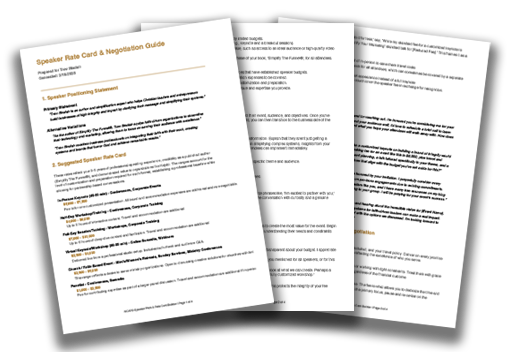
the first step is to go and complete our speaker rate card assessment tool. This will give you guidance on how you can put together your one sheet.
Next, pull up your current one-sheet right now. Read the first line. Does it tell a planner what you do for an audience, in one sentence, without ambiguity?
If not, that's your starting point. Rewrite the headline. Then move your client logos and testimonials to the top third. Tighten your talk titles. Add a clear call to action.
At NCAPS, we equip Christian speakers to build the business side of their speaking with the same excellence they bring to the stage. Join the community at ncapspeakers.org and develop the skills, systems, and connections that move careers forward.